The Growing Role of GPS Technology in Family Safety
Not long ago, GPS was something most families encountered only on a car navigation screen. Today, the same technology sits in nearly every smartphone, and it has quietly become one of the most practical tools parents and loved ones have for staying connected and safe.
This article looks at how GPS is being used in family safety, where it genuinely helps, where its limits are, and how to introduce it in a way that builds trust rather than tension.
From Navigation to Peace of Mind
The core idea behind a family locator app is simple: a phone determines its position and shares it with people you have chosen to trust. What has changed is how useful that information has become in daily life.
Instead of a string of "Where are you?" texts, a quick glance at a map can answer the question. Instead of wondering whether a teenager made it to practice, a parent can receive a notification when they arrive. The technology does not replace conversation; it removes some of the uncertainty that tends to fill the gaps between conversations.
How Real-Time Location Sharing Supports Families
Real-time location sharing is most valuable when it solves specific, everyday problems. A few common examples:
- Coordinating busy schedules. Knowing that someone is ten minutes away makes pickups, dinners and carpools easier to plan.
- Confirming safe arrivals. Whether it is a child walking home from school or an adult driving late at night, knowing they arrived removes a source of worry.
- Responding quickly when something goes wrong. If a family member needs help, knowing their location can save valuable time.
- Supporting older relatives. Adult children often use location sharing to keep a gentle eye on parents who live alone or travel independently.
In LifeCircle, every member of your circle appears on a live map along with their latest address and how recently they checked in, so you can see at a glance whether the information is current.
Beyond the Map: Features That Add Context
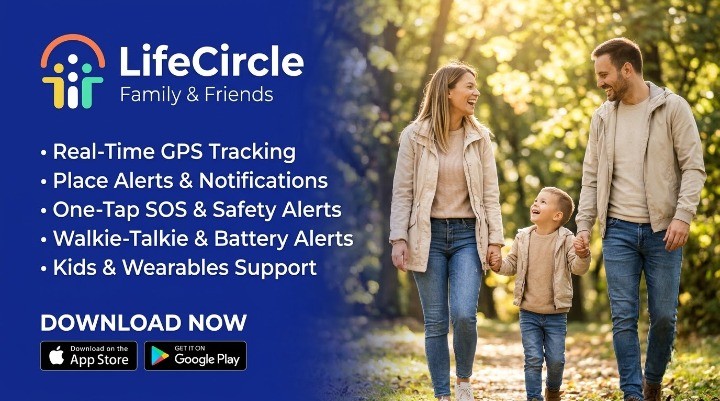
A dot on a map is only part of the picture. Modern family safety tools combine GPS with other signals to make location information more meaningful.
Place alerts
Saving familiar places such as home, school or work lets you receive a notification the moment someone arrives or leaves. For many parents, this is more useful than checking a map repeatedly, because the information comes to you only when it matters.
Location history
Being able to retrace a route stop by stop can help if a phone is lost, if plans need to be reconstructed, or simply to understand a family member's typical routine. LifeCircle plans offer different history windows, from two days on Silver up to fourteen days on Platinum.
Driving and battery awareness
Speed alerts let you know when a family member exceeds a speed limit, which can open the door to a calm conversation about safer driving. Battery status warnings tell you when a loved one's phone is running low, so you can check in before they go dark.
SOS
A one-tap SOS lets someone signal for help without saying a word. Their circle instantly receives their location and an emergency alert. It is important to remember that this alerts family and friends; in a genuine emergency, always contact your local emergency services as well.
Understanding the Limits of GPS
GPS is powerful, but it is not perfect. Setting realistic expectations helps everyone use it well.
- Accuracy varies. Tall buildings, indoor locations and poor signal can affect how precise a position is.
- Phones need power and connectivity. A switched-off or dead phone cannot share its location. Battery alerts help, and LifeCircle Gold adds offline and no-network alerts, but no tool can locate a device that is completely unavailable.
- Technology is a supplement, not a substitute. Location sharing works best alongside clear family agreements about check-ins, curfews and what to do in an emergency.
Privacy and Trust Come First
The growing role of GPS in family life raises a fair question: how much visibility is appropriate? The answer depends on age, maturity and the relationship involved, but a few principles apply broadly.
- Be transparent. Location sharing should never be secret. Explain what is shared, who can see it and why.
- Match the approach to the age. Younger children may need closer oversight, while teenagers and adults deserve more autonomy and a say in how sharing works.
- Keep circles small and intentional. Share with the people who genuinely need the information.
- Allow breathing room. Agree on when it is reasonable to pause sharing.
LifeCircle is private by design. Circles are invite-only through a unique code, and members can pause sharing or leave a circle whenever they like. You can also create separate circles for family, friends, carpools or teams, controlling who sees what.
GPS for Younger Children
Children who are not yet ready for a full-featured phone experience have different needs. The Find My Kid app is designed for this situation: a child installs it on their device and pairs it with a parent's phone using a code, while the parent uses the Family & Friends app.
Find My Kid is included for one child on the Gold plan and for up to ten children on Platinum, which also adds parent and kid smartwatch support. Whatever tool you use, pair it with age-appropriate safety lessons, such as memorising a parent's phone number and knowing which trusted adults to approach for help.
Getting Started Thoughtfully
If you are considering a family locator app, a measured rollout tends to work best:
- Talk with your family about the reasons before installing anything.
- Start with a few essential place alerts, such as home and school.
- Review settings together and agree on how SOS should be used.
- Revisit the arrangement as children grow and circumstances change.
You can compare what each membership includes on our plans section or explore the full list of features. If you have setup questions, our help centre walks through the basics.
Final Thoughts
GPS technology has become a quiet but meaningful part of family safety. Used openly and with clear expectations, real-time location sharing can reduce worry, simplify coordination and help loved ones respond faster when it counts.
If you would like to try it with your own family, you can download LifeCircle and set up your first circle in a few minutes.